
AI Shovelware Is Drowning Honest Indie Games
Roughly 1 in 3 new Steam games now discloses AI use, and players are punishing the shovelware. The tool is not the enemy. Treating it as the product is.
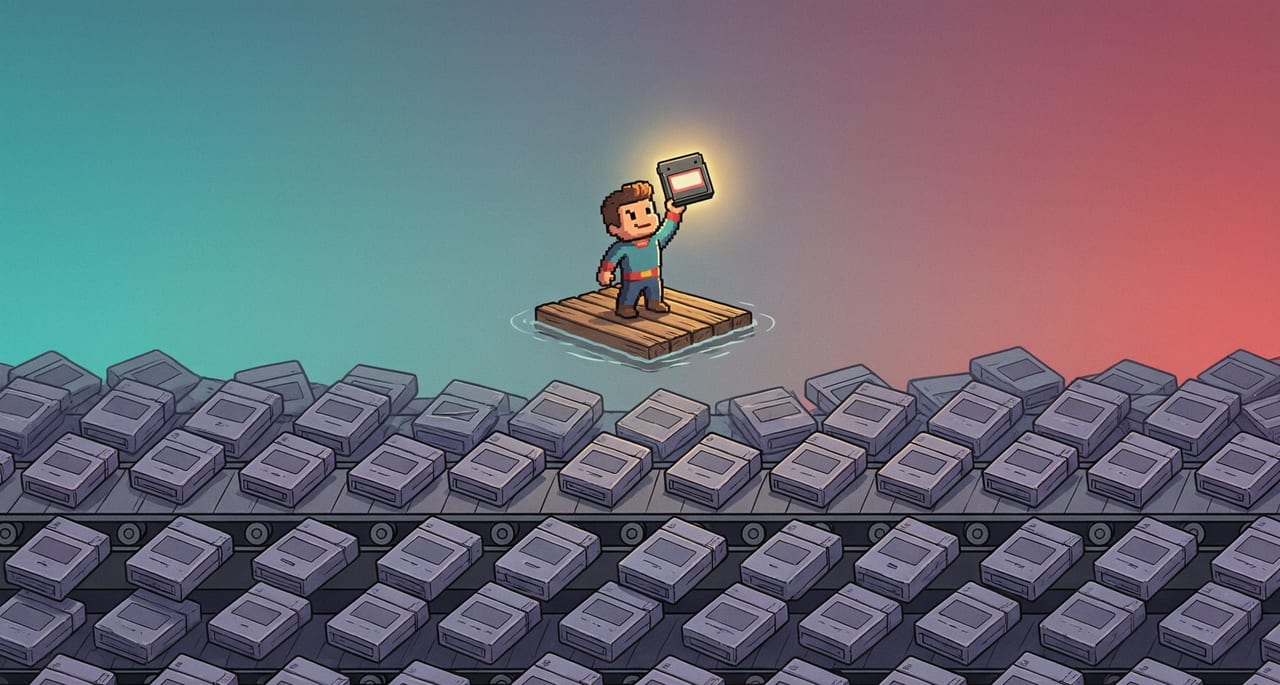
Steam is not short of games. In the week ending August 30, 2026, it took in a record 720 of them. The crisis facing small developers is no longer whether you can finish and ship a game. It is whether anyone can find it under the pile. And a growing share of that pile is being generated, not made.
The flood has a disclosure label now
On July 13, 2026, industry analyst Sulka Haro published "Three years of AI on Steam," an independent census of 53,597 games released between July 2023 and July 2026, sorted by their store-page AI Generated Content disclosures. The trend line is steep. In 2024, about 10.9 percent of new games carried an AI disclosure. In 2025 it was 19.9 percent. In 2026 it reached 30.8 percent, roughly one in every three new releases. Because Steam only requires disclosure of player-facing AI content, not backend code assistance, the real figure is almost certainly higher.
Valve codified that split in January 2026. Using AI to write code or speed up a pipeline does not need declaring. Shipping AI-generated art, audio, narrative text, or store assets does, and players can now report undisclosed use straight from the Steam Overlay. The policy is a tell. An industry only builds a mandatory "this uses AI" label when trust in the label's absence has already eroded.
Players are voting, and the verdict is harsh
On August 12, 2026, two Northeastern University researchers published a study of 508,192 English Steam reviews. They compared 166,745 reviews across 5,970 games that disclosed generative AI against 341,447 reviews across 5,186 games using procedural content. The gap was stark. Procedurally generated games earned an 86.3 percent recommendation rate and 69 percent positive sentiment. Games disclosing generative AI managed 68.4 percent and 53 percent. When the researchers read 600 reviews that mentioned AI directly, the complaints repeated: rough visuals, stiff voice work, unproofed text, and a recurring suspicion that the developer cut corners. PC Gamer's own data coverage put a number on the reach problem, finding AI-disclosed games draw roughly 53 percent fewer reviews on average.
Read together, the picture is not that players hate technology. It is that they have learned to associate a disclosure label with a specific kind of low-effort product, and they are pre-emptively walking away from it. A genre slang has even formed around the worst offenders: gameslop.
The knockoff engine runs on the same fuel
The damage is not only volume. It is speed. Nick Kaman, co-founder of Aggro Crab, the studio behind the 2025 co-op hit PEAK, has been blunt that clone games have existed for decades, but AI has pushed the turnaround from months to days. Cheap AI-made PEAK imitations have already surfaced for sale. When a title stitches together Palworld, Pokemon, and Breath of the Wild, as the "Pickmon" clone did, GamesRadar's review did not even need to confirm the method: it said the game "reeks of AI slop." For every honest solo developer spending a year on one weird, personal game, there is now an actor who can flood the same search results in an afternoon.
The fair counterpoint
This deserves a real defense, not a strawman. AI has genuinely lowered the barrier to entry, and that is a good thing. A solo developer who cannot draw can now ship a game with competent placeholder art. A tiny team can prototype in a weekend what once took a quarter. More people can turn an idea into a playable thing than at any point in history, and the games-as-expression argument is real. Procedural generation, which players still reward with an 86.3 percent recommendation rate, has always been a form of algorithmic content creation, and nobody calls a roguelike's random dungeon "slop."
There is also a fairness problem in the stigma itself. A disclosure label cannot distinguish a lazy cash-grab from an honest three-person team that used AI for background music and said so. Punishing transparency pushes developers toward hiding their tools, which helps no one. And the reflex "AI equals bad" ignores that plenty of AI-disclosed games are perfectly good, while plenty of hand-made games are tedious.
What this means for you
If you make games, the lesson is not to abandon the tools. It is to stop treating the tool as the product. Use AI to close a gap in your skills, not to replace the taste, the point of view, and the hundred small decisions that make a game feel like someone cared. Disclose honestly, because the developers who get punished hardest are the ones caught hiding it. The market is not rejecting AI. It is rejecting the absence of a human reason to exist.
If you play games, resist both reflexes. Do not assume a disclosure label means garbage, and do not assume a pretty capsule means craft. Read a few reviews, watch actual footage, and give the weird, obviously-handmade thing a chance. The best counter to gameslop is not an algorithm. It is attention, spent on purpose. Two-person teams still make miracles, as we covered in "Meccha Chameleon Is 2026's Best-Selling Game," and the discovery crisis behind all of this is the one we mapped in "Steam Shipped 720 Games in a Week, and 74% Sank." The flood is real. So is the good stuff underneath it. Someone has to go looking.