
The Steam Machine Is Back: Should Indie Fans Care?
Valve's living-room box returns as one $1,049 cube. The raw specs underwhelm next to a PS5, but for an indie-heavy Steam library it's a different story.
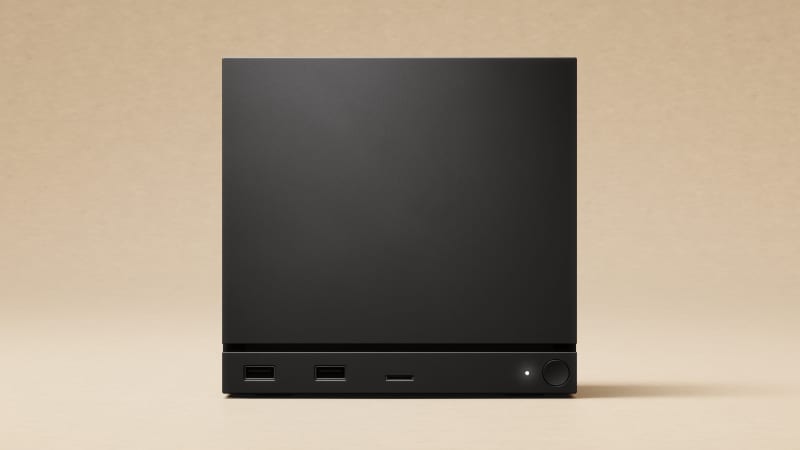
The Steam Machine is back. A decade after Valve's first swing at a living-room PC quietly fell apart, the company is selling a small black cube that runs your entire Steam library on the TV, with no Windows and no fuss. It starts at $1,049 for the 512GB model ($1,349 for 2TB), the first units ship on June 30, and the early reviews are already in and politely unimpressed. For the kind of library our readers actually own, though, the spec-sheet read and the real read are two very different things.
A decade-long road back
Valve first announced Steam Machines in September 2013, alongside SteamOS and the original Steam Controller. The pitch was a fleet of partner-built boxes, from Alienware to Zotac to Origin PC, all running a free Linux-based OS in the living room. After a delay out of 2014, about 15 models launched on November 10, 2015, spanning roughly $450 to nearly $6,000.
They flopped, and the reason matters because it is exactly what has changed. SteamOS in 2015 ran Linux, and most games were Windows-only, so your library mostly did not run. The boxes cost as much as a do-everything Windows PC while doing less, and a console did the couch job for half the money. Valve never published sales numbers. The 500,000 figure people still cite was actually Steam Controllers sold in the first seven months, and since one shipped with every machine, the real Steam Machine count was read as well below that. By early 2018, Valve had quietly pulled Steam Machines from the store's main menu. It was not a formal discontinuation, but the message landed anyway: "Steam Machines aren't exactly flying off the shelves," as Valve's Pierre-Loup Griffais put it.
What fixed the fatal flaw came later. In 2018 Valve shipped Proton, a compatibility layer that lets Windows games run on Linux, and it worked well enough that the 2022 Steam Deck, running a rebuilt SteamOS, became the success the Steam Machine never was. The Deck Verified program told you at a glance whether a game just worked. By the time the new Steam Machine was announced in November 2025, the compatibility problem that sank the original was, for most of the catalog, solved.
What the new Steam Machine actually is
This time there is no confusing lineup. The Steam Machine is one box, designed and built by Valve: a black cube about 6 inches (16 cm) a side, around 2.6 kg, with a magnetic faceplate and an RGB light bar. Inside is a semi-custom AMD chip, a 6-core, 12-thread Zen 4 CPU paired with an RDNA 3 GPU (28 compute units, 8GB of dedicated video memory), plus 16GB of system RAM. Valve says it is roughly 6 times more powerful than a Steam Deck and pitches "up to 4K" gaming with FSR upscaling, though Valve's own engineers call 1440p the honest sweet spot.
Price: $1,049 (512GB) or $1,349 (2TB); a Steam Controller bundle adds $79
Shipping: first units ship June 30, 2026, to a randomized reservation queue (sign-ups already closed) rather than first-come pre-orders
OS: SteamOS 3, with Proton handling Windows games
Where to get it: Steam's hardware page
The price is the sting. Valve had signaled something cheaper (the press pegged the original target somewhere around $750), but a global memory and storage shortage drove RAM costs up, the launch slipped out of its early-2026 window, and the final number landed higher than anyone hoped.
The reviews are lukewarm, and that is the wrong yardstick for us
Reviewers had their units ahead of the June 30 launch, and when the first verdicts landed in late June, outlets like Digital Foundry and GamersNexus were measured. The GPU sits around an RX 6600 or RTX 3060, roughly 2019-era raster performance, and a base PS5 that costs hundreds less actually beats it in several demanding games at 4K. As a pure price-to-blockbuster-frames machine, it is a hard sell.
But that benchmark, maxed-out AAA at 4K, is not the library most of our readers are playing. Hades, Balatro, Stardew Valley, Vampire Survivors, Dave the Diver, and Hollow Knight are not GPU-bound, and a box like this runs them at high frame rates without ever spinning its fan up. The reviews are right about what they measured. They are just measuring a shelf of games that is not ours.
How it runs the games we cover
This is where the Steam Machine makes sense. It runs SteamOS with Proton, the same proven stack as the Steam Deck, and any game marked Verified for the Deck is automatically Verified here too. As of late 2025, community testing put roughly 90% of the Steam catalog in the playable column. The main thing that still does not work is the kernel-level anti-cheat in a handful of competitive shooters like Valorant and Fortnite, which barely touches an indie shelf.
For a cozy-and-roguelike backlog, that means close to everything you own just works, on the TV, from the couch, with a controller, and with no Windows to manage. Plug it in, sign in, and your existing library is there. That "your Steam library on the big screen, no fuss" promise is the exact one the original Steam Machine made in 2015 and could not keep. In 2026 it finally keeps it.
Who it is for, and who should wait
The hardware works. The question is the price. At $1,049, the Steam Machine asks a lot to play games that, in many cases, already run on the Steam Deck in your bag or a cheap mini PC under your TV. If you have a big Steam library that leans indie, you want it on the living-room screen, and the no-Windows simplicity is worth real money to you, this is the cleanest way to get there that Valve has ever shipped. If you are price-sensitive, or you mostly want the latest blockbusters at 4K, your money goes further elsewhere right now, and waiting for the memory-shortage premium to ease is no sin.
We have not put a unit on our own TV yet, so we are holding our formal recommendation until we do. When we get one in, we will tell you exactly how it runs the games we cover, and whether that price earns it.